Frame the comparison between Ozone and UV-C radiation as a direct competition often leads to simplistic conclusions. From a technical standpoint, it is not about deciding which one "wins," but rather understanding which problem each technology solves, under what conditions they function correctly, and what their physical and operational limits are. Only through this analysis is it possible to evaluate why, in certain systems, the combination of both is not redundant but complementary.
UV-C radiation is a physical disinfection method based on electromagnetic energy. Its action is well-documented: when it hits microorganisms, it causes alterations in their genetic material that prevent replication. The critical parameter is not the mere presence of UV-C, but the effective dose received by the target surface. This dose is the result of irradiance, exposure time, distance to the source, and the geometry of the object. Under controlled conditions, UV-C allows for highly repeatable and measurable processes, making it a predictable technology from an engineering perspective.
However, this same physical nature introduces a structural limitation: UV-C radiation operates via line-of-sight. It does not penetrate opaque materials nor does it significantly "wrap around" obstacles. In objects with complex geometry, deep cavities, padding, or folds, there will always be areas with lower exposure. This is not a defect of UV-C, but a direct consequence of its mechanism of action.
Ozone operates under a completely different principle. It is a gaseous oxidizing agent that reacts chemically with the cellular components of bacteria and other microorganisms. Its main advantage is not speed or precision, but its diffusion capacity. As a gas, it can reach areas where radiation cannot, including internal spaces, crevices, and hidden areas. This makes it especially relevant in applications where the geometry of the object limits the exclusive use of optical methods.
This advantage comes with operational restrictions. Ozone’s effectiveness depends on concentration, contact time, and environmental conditions. Furthermore, its use requires controlled cycles and subsequent phases to ensure that no gaseous residues remain on the treated object. From a process standpoint, it is less immediate than UV-C and requires more careful management of timing and sequences.
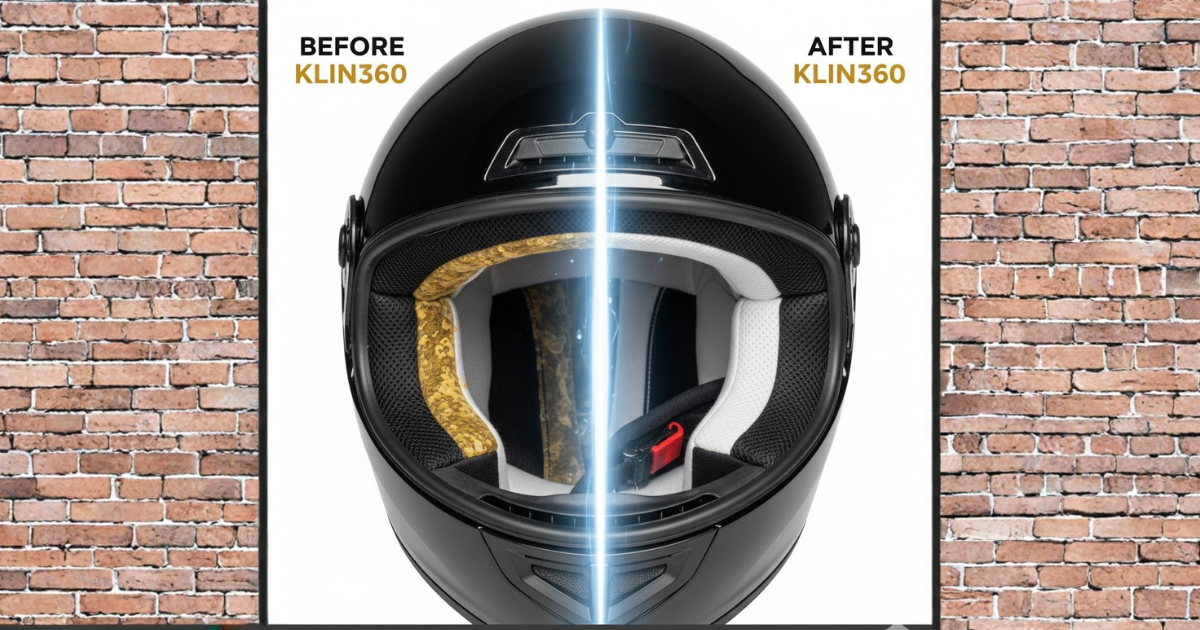
When analyzing an object like a helmet, these differences cease to be theoretical. A helmet is not a flat surface: it combines rigid polymers, foams, textiles, seams, vents, and irregular internal volumes. Claiming that a single technology uniformly covers all these elements implies assuming ideal conditions that rarely occur in practice. UV-C is effective on exposed surfaces; ozone can act where light cannot reach. Each fills the operational gaps of the other.
From an applied engineering perspective, the relevant question is not which technology eliminates more bacteria in the abstract, but how to design a process that consistently reduces the microbial load on a real object used daily under variable conditions. In this context, the combination of Ozone and UV-C does not seek to indiscriminately add effects, but to balance different physical limitations within the same cycle.
KLIN360 adopts this integrated approach in an automated system. Automation does not alter the intrinsic properties of Ozone or UV-C, but it does control the critical variables: timing, sequence, repeatability, and process isolation. By encapsulating both technologies in a defined cycle, dependence on the human factor is reduced, seeking consistency across uses regardless of the installation point or operator.
In technical terms, this shifts the discussion from a superficial comparison of technologies toward comprehensive process design. Ozone and UV-C are not magic or interchangeable solutions; they are tools with different scientific foundations. Used in isolation, each leaves areas uncovered. Integrated rationally, they allow for a robust operational approach to a complex hygiene problem.
Ultimately, real effectiveness is not defined by the name of the technology, but by how it is applied, controlled, and validated. This is the point where science stops being a theoretical argument and becomes a technical standard.